
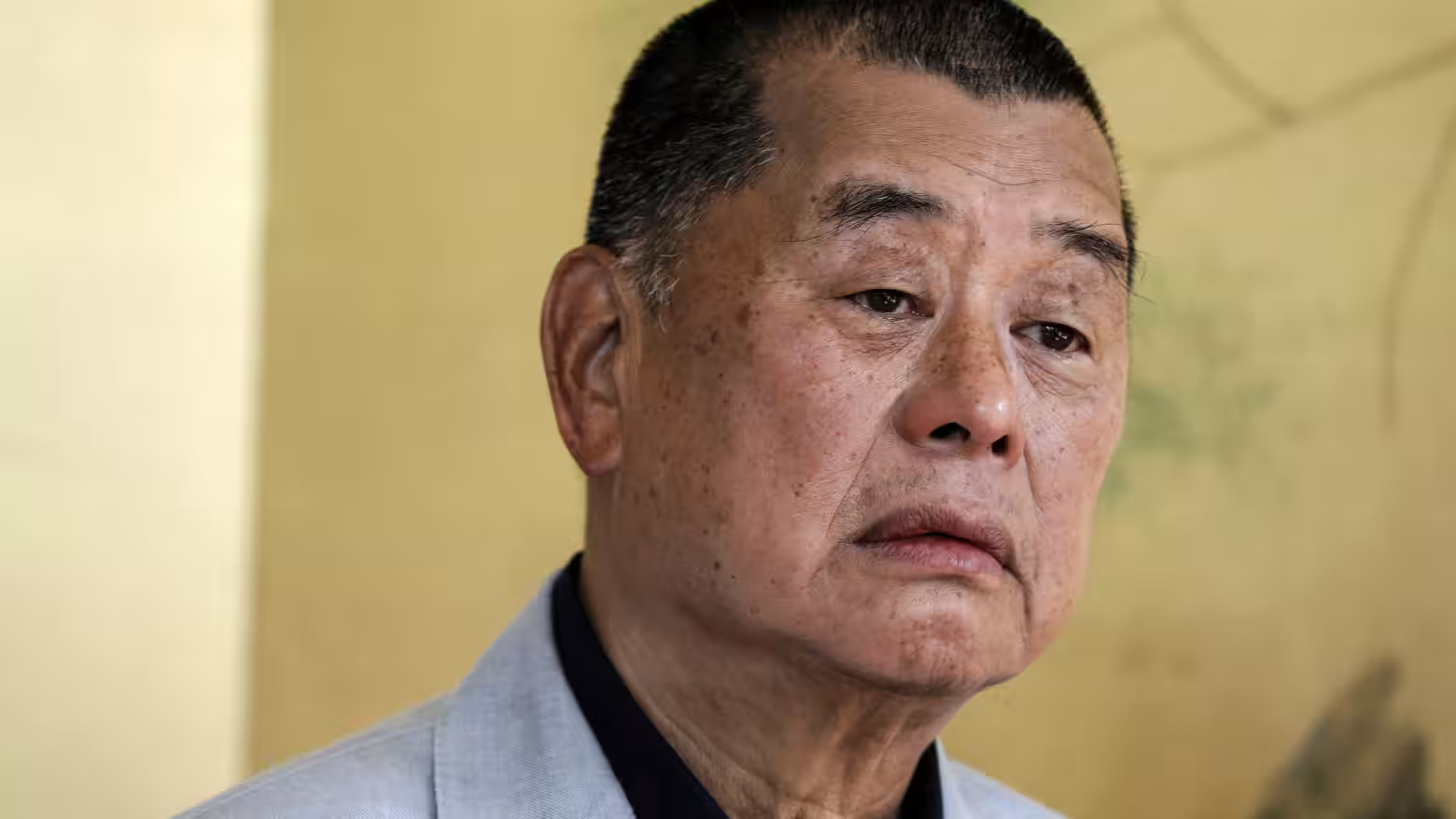

On 15 December 2025, Hong Kong’s most prominent pro-democracy media figure, Jimmy Lai — founder of Apple Daily and a long-standing critic of Beijing — was convicted in a high-profile national-security trial. The court found Lai guilty of conspiring with foreign forces and publishing seditious material; he faces a still-pending sentence that could be decades long. The trial, held without a jury, drew condemnation from rights groups and Western governments and was defended by Beijing and Hong Kong authorities as lawful and necessary to protect national security.
Brief Context
Hong Kong went from a British colony to a Special Administrative Region under “one country, two systems.” For decades, Hong Kong kept separate legal institutions, freedoms of assembly and press, and an open economy that contrasted with the mainland. Over the last decade, that separation has eroded, particularly after the 2019 mass protests and Beijing’s 2020 imposition of a broad national security law that criminalized acts the mainland defines as secession, subversion, terrorism, or collusion with foreign forces. That law, and subsequent prosecutions, have reoriented Hong Kong’s politics and legal risk landscape.
The 2019 protests
What began as opposition to an extradition bill in mid-2019 escalated into the largest protest movement in Hong Kong’s history, with sustained street actions, decentralised organization, and five core demands: withdrawal of the bill, inquiry into police conduct, amnesty for arrestees, democratic reform, and no characterization of protesters as “rioters.” The movement deeply polarized the city and prompted a forceful police response; by the time the protests subsided, thousands had been arrested. Authorities and Beijing framed the unrest as foreign-backed destabilization, which helped underpin the later use of the national security law.
Crackdown and the roll-up of dissent
Since 2020, the security law and other measures have produced waves of charges and convictions that targeted leaders, organisers, journalists, and civic groups. Large numbers were arrested under ordinary criminal statutes and under the security law; prominent figures such as Joshua Wong, Agnes Chow, and many former legislators and activists were prosecuted, and dozens of civil society groups either dissolved or were deregistered. The result has been the near-elimination of organised opposition within the formal political arena and a chilling effect on media and academia. Recent datasets and reporting document thousands of arrests and hundreds of prosecutions connected to the movement and its aftermath.
Election Reform
Hong Kong’s post-2019 election reforms fundamentally redefined who can participate in politics and how power is allocated. Under the principle of “patriots administering Hong Kong,” political eligibility is no longer a civil right but a conditional status. Candidates are now subject to loyalty vetting overseen by bodies linked to national security authorities, with little scope for judicial review. Convictions under national security laws — including cases like Jimmy Lai’s — effectively bar individuals from holding office.
Structurally, representative institutions have been redesigned to minimize electoral uncertainty. The number of directly elected seats in both the Legislative Council and District Councils has been sharply reduced, while indirectly selected or appointed members — largely aligned with Beijing — now dominate. The expanded Election Committee plays a central role in selecting legislators and the Chief Executive, transforming elections from competitive contests into managed selection processes.
Public participation has declined accordingly. Turnout in elections held under the new rules has fallen, reflecting widespread disengagement rather than apathy. When candidate choices are tightly circumscribed, voting loses its function as a meaningful expression of political preference.
Officially, the reforms are framed as necessary to restore stability after the 2019 protests and to prevent subversion or foreign interference. In practice, they have eliminated organized political opposition. Pro-democracy parties have disbanded, opposition figures are imprisoned, exiled, or barred from running, and legislative bodies no longer function as sites of adversarial debate.
By redefining political opposition as a national security risk, the reform collapses the distinction between disagreement and subversion. Loyalty vetting replaces policy debate as the primary criterion for political participation. Additionally, the low voter turnout under the new system signals rational disengagement, not public satisfaction. When electoral outcomes are effectively predetermined, participation loses meaning. Over time, legitimacy derived from procedure alone erodes, forcing authorities to rely more heavily on enforcement and narrative control rather than consent. Most critically, the reform closes off lawful pathways for political change. When elections no longer offer a route for dissent, pressure migrates outside formal institutions into silence, exile, or latent resentment, which will backfire upon Beijing.
Jimmy Lai’s place in the story
Lai symbolised two threats to Beijing: a high-profile, well-funded critic with international ties, and a media platform that amplified dissenting narratives. Apple Daily’s closure in 2021 after asset freezes and arrests removed one of the last major pro-democracy newsrooms. The Lai conviction operationalises the security law against high-profile media and civic actors and signals the limits of acceptable dissent. International reactions ranged from sharp rebukes and calls for release to Chinese and Hong Kong authorities’ insistence that the verdict defends state security.
Implications:
From “rule of law” to “rule by law”
Hong Kong once differentiated itself from mainland China through an independent judiciary and predictable legal standards. The Lai case signals a shift from the rule of law as a constraint on power to rule by law as an instrument of power. The national security framework does not abolish courts but rather repurposes them. Trials without juries, broad definitions of “collusion,” and the retroactive reinterpretation of journalistic activity redefine legality. This means that legal compliance no longer guarantees political safety and the boundary between lawful speech and criminal behavior is intentionally elastic. In other words, if you don’t fall in line with the CCP, not even the law will protect you.
The Death of Proper Media
The conviction of a media owner — rather than a street protest leader — underscores that Beijing views information control as more threatening than physical mobilization. The collapse of Apple Daily and Lai’s imprisonment imply that journalism is no longer treated as a protected civic function but as a potential security liability. This also means that media pluralism will not be restored through market forces; capital alone cannot revive independent outlets if political permission is absent.
The long-term implication is detrimental: Hong Kong may retain news organizations, but not investigative adversarial journalism. This weakens accountability not just politically, but economically — corruption, regulatory capture, and corporate malfeasance become harder to expose.
Ending
Jimmy Lai’s conviction is both an endpoint and a signal. It closes a chapter on one of Hong Kong’s most visible critics and reinforces a new equilibrium: political contestation is increasingly litigated and criminalised, public space is narrowed, and the city’s distinctive freedoms are reshaped. For policymakers, journalists, and civil-society actors, the immediate task is not only to interpret the legal judgments but to map pragmatic responses that protect people at risk, preserve credible channels for information and advocacy from outside and inside Hong Kong, and prepare for long-term political realignments in the region.

Leave a Reply