
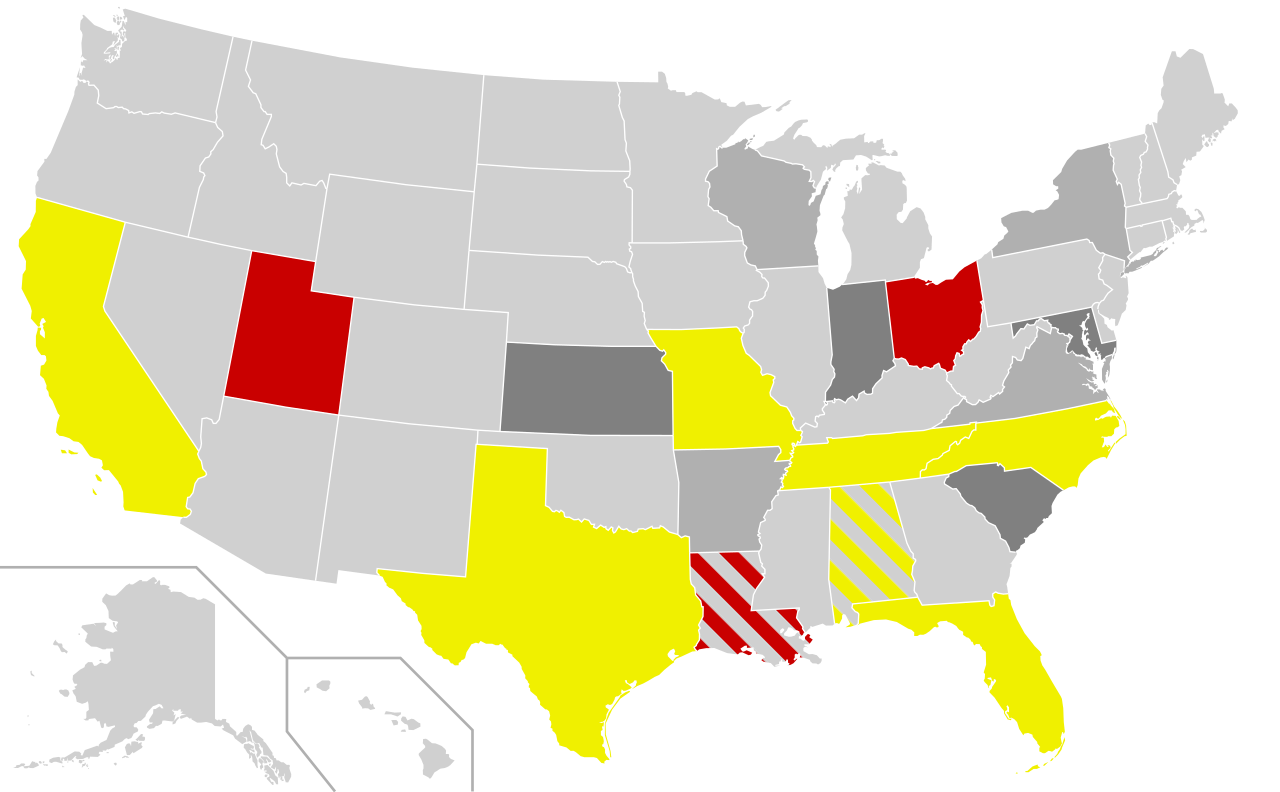

On April 29, 2026, the U.S. Supreme Court handed down one of the most consequential redistricting decisions in a generation. In Louisiana v. Callais, a 6–3 majority struck down Louisiana’s congressional map as an unconstitutional racial gerrymander. In doing so, this decision effectively gutted Section 2 of the Voting Rights Act of 1965. The ruling has set off a rapid, state-by-state scramble to redraw congressional maps before the 2026 midterms. Here are all the recent developments in this latest segment of the redistricting wars, and what these developments mean for the future.
Louisiana v. Callais
The case arose from Louisiana’s long-running effort to draw its congressional districts following the 2020 census. After years of litigation under Section 2 of the VRA, a federal court had ordered the state to create a second majority-Black district, which the legislature did in 2024. A group of voters calling themselves “non-African American” challenged that map as an unconstitutional racial gerrymander under the 14th and 15th Amendments.
Writing for the majority, conservative Justice Samuel Alito ruled that Section 2 of the Voting Rights Act did not require Louisiana to have a second Black district. Critically, the Court made it more difficult to prove that racial gerrymandering had occurred. The liberal Justices in this case dissented, with Justice Elena Kagan saying that the ruling essentially renders Section 2 dead. Critics of the decision argue that the new standard — allowing maps to stand unless lawmakers explicitly express racially discriminatory intent — effectively permits partisan gerrymandering to serve as cover for racial discrimination. It is important to keep in mind that more than 90% of African Americans in the South vote Democratic.
Louisiana
The decision landed just days before Louisiana’s scheduled May 16 congressional primaries. Governor Jeff Landry (R) immediately issued an executive order suspending those primaries to allow the legislature to draw a new map compliant with the ruling. On May 4, the Supreme Court expedited its own judgment, making the Callais decision effective immediately and clearing the way for the redistricting effort to proceed before November. Louisiana’s primaries have been pushed to July 15, or a date to be set by the legislature. This is even though early votes had already been cast. Louisiana is currently in the process of passing a new congressional map, one that would get rid of its second Black district. This would flip one House seat from Democrat to Republican.
Alabama
Alabama moved faster than any other state. The day after the Callais ruling, Governor Kay Ivey (R) called a special legislative session, and the state filed an emergency motion with the Supreme Court to lift injunctions blocking its 2023 congressional maps — maps that federal courts had previously struck down for diluting Black voters’ power under Allen v. Milligan (2023). The Alabama Legislature had passed legislation during that session authorizing special primary elections in affected districts if the Supreme Court allowed the change. On May 11, the Court granted Alabama’s request in a 6–3 decision, clearing the way for the state to use the previously blocked 2023 map. The move is expected to flip at least one House seat from Democrat to Republican, with the governor calling special primaries for the newly drawn districts.
Tennessee
Governor Bill Lee (R) called a special session for May 5. The legislature acted on May 7, passing a new congressional map that divides the state’s only majority-Black district centered in Memphis into three safe Republican districts. After the 2020 census, the legislature had split the city of Nashville, formerly in its own safe Democratic district, into two Republican districts. This move would effectively erase Democratic representation from the state.
Other States
It is way too late for most other states in the South to try to redraw their districts. Florida has already done so, gutting four Democratic districts and making them more Republican-leaning. The South Carolina House of Representatives moved to pass an effort that would have gotten rid of the state’s lone majority Black congressional district, but this has been blocked by the South Carolina Senate for now. In Missouri, the state’s supreme court upheld a new congressional district map that would flip one district from Democratic to Republican.
Impact
These moves being made by President Trump and the Republicans are part of an effort to keep the House of Representatives in Republican hands. With President Trump’s approval ratings at an all-time low, it is highly expected that there will be massive backlash against the President’s Republican Party, which controls both houses of Congress. Redistricting efforts made by the Republicans by this point will likely net them up to a dozen seats from Democratic to Republican. Several other Republican strongholds that have not redistricted this year will also likely try to redraw ahead of 2028.
As for the Democratic Party, they are looking to fight back. California voted to redraw its congressional districts last November, netting it five more Democrats. Virginia voted to redraw its own congressional districts last month, although the referendum’s results were struck down by the state’s supreme court, and officials are appealing that decision in a last-ditch effort to the Supreme Court. Virginia will likely attempt again to redistrict before 2028. Officials in several big Democratic states, such as Colorado, Illinois, Maryland, New Jersey, New York, Oregon, and Washington, are also planning to redistrict to retaliate against Republican efforts, although such efforts likely will not be done until after this year’s midterm elections.
This is a whole new front in the redistricting wars. A realistic scenario in the near future would involve the vast majority of Americans living in gerrymandered districts, with one party controlling all or most of the House seats in a state, regardless of what percentage of the vote a party receives in an election. The only real way to put an end to these redistricting wars would be to stop gerrymandering. However, such a ban would not pass under this Congress and this administration. Thus, the redistricting wars continue.

Emil Ordonez, a political science major at Fordham University, is the founder and editor-in-chief of Polinsights. He has been deeply passionate about politics and history since learning every U.S. President at the age of five. He was compelled to start this blog after meeting many people who were misinformed or had become apathetic about how society worked. He hopes to provide factual knowledge and insights that will encourage people, especially the young, to get more engaged in their respective communities. In his free time, he edits for Wikipedia and makes maps for elections. He aspires to work in Congress or even the White House in the future.
Leave a Reply